The Collaborative Innovation Center of Advanced Microstructures (CICAM), led by Nanjing University, was established under the 2011 Plan, an initiative of the Chinese Ministry of Education and Ministry of Finance to develop the innovation capacity of universities across the country. The plan was introduced as an important strategic measure in China's higher education system and through the establishment of Collaborative Innovation Centers has focused on four key categories:
frontier science, industrial development, regional development and cultural heritage. In an evaluation by the Ministry of Education in early 2014, CICAM was rated top of all the Collaborative Innovation Centers considered.
CICAM concentrates on conducting interdisciplinary research on advanced and artiflcial microstructure materials where micro- to nano-scale features give rise to interesting properties, which can be exploited for a range of technological applications. Researchers at CICAM conduct fundamental research on advanced and artificial microstructures and also work to translate their
findings into relevant applications.Through these efforts CICAM aims to establish itself as a leading centre in thefild, producing research that catalyses Chinese industry and meets their technology needs.The centre is also committed to training researchers and drawing prominent scientists from across the country to become a world-class scientifi institution.
CICAM is the result of a partnership between several universities, research institutes and companies located in the Yangtze River Delta region, a thriving area for science and education in China with a very active high-tech industry.The partner institutions have a long history of cooperation in large research pr,ojects and are committed to sharing the responsibilities and benefits of CICAM.
THE STRENGTH OF COLLABORATIVE INNOVATION
ICAM's collaborative approach takes full advantage of the expertise cultivated in fiveestablished research platforms, including the National Laboratory of Solid State Microstructures at Nanjing University, to create an environment conducive to innovation on a par with that achieved by the
international community.
CICAM is responsible for 60 major national research projects with a total research budget of RMB 380 million approximately USD 62 million). Its research on dielectric superlattices and iron-based superconductors is among the strongest in the world. It has also yielded numerous important advances in the areas of optics, acoustic diodes, quantum integrated chips, high-temperature superconducting materials and their mechanisms, quantum spin Hall systems,
entangled edge states, nanophotovoltaics, all-solid-state laser microstructures and micro-nanofa brication technologies. For example, CICAM researchers have designed a semiconductor laser array chip based on artificial microstructures, which entered into Huawei Technologies'industrial exploration programme on photonic integrated devices in 2013.
CICAM has attracted the attention of the scientific community for the high quality of its research as well as its implementation of novel and innovative training solutions for talented young scientists, such as personalized training for top students. An eight-year programme at the centre covering undergraduate-, masters- and PhD-Ievel study has proved very successful.
Overall, CICAM delivers some of the best science conducted in China today. It is a dynamic centre for both research and researcher development, exploring novel approaches to artifiial microstructures and producing original research to meet the country's core technology needs.
NANJING UNIVERSITY
Advertiser retains sole responsibility for content
Nanjing
Nanjing has long been a hotbed for scientific discovery and technological innovations. Now, through promoting materials science and astrophysics, the former capital city hopes to step out from the shadows of its neighbor and rival Shanghai.
ARTICLE COUNT(AC):795
FRACTIONAL COUNT(FC):362
WEIGHTED FRACTIONAL COUNT(WFC):310
Nanjing ,surrounded by green mountains and rivers, is the capital city of Jiangsu province. Though it has long been a popular destination for tourists, the‘ancient capital’ is often overlooked by foreign investors who flock to nearby, and much larger,Shanghai.
Nanjing's 2012 budget for scientific research and development was US$1.5 billion, comprised of equal contributions from local government and industry. The city's eight pillar industries in the high-tech sector are supported by more than 100 universities and research institutions, including the premier institution for education-- Nanjing University (NJU).
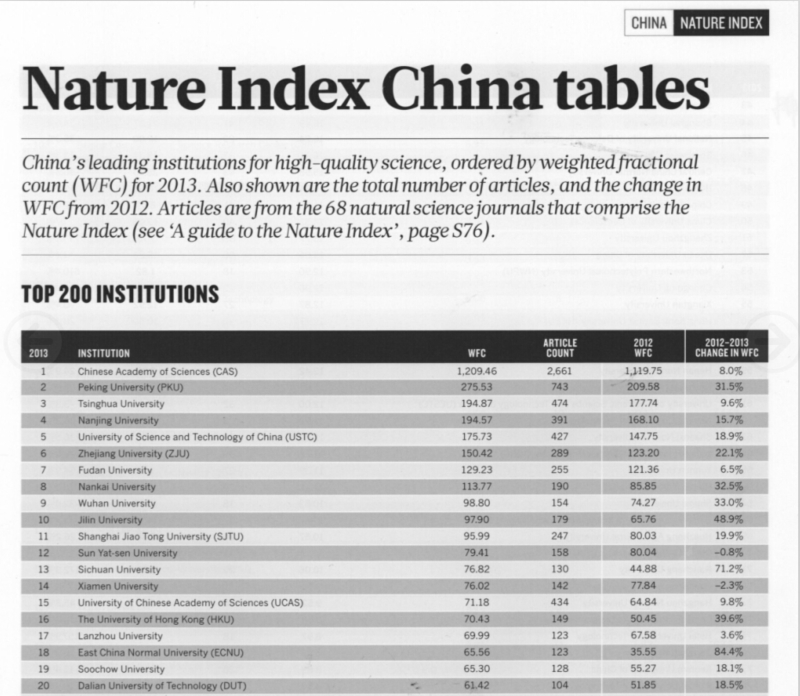
NJU is by far Nanjing's largest contributor to the Nature Index, and fourth overall in China by weighted fractional count (WFC). In 2013, the university published 391 articles (WFC = 194.6), accounting for 64% of the city's WFC. Despite his output, NJU contributed only one article(WFC = 0.05) to Science and none to Nature.
NJU derives most of its WFC from chemistry. Huangxian lu, Jingjuan Xu and Hongyuan Chen from the school of chemistry and chemical engineering are NJU's largest contributors, Ju-- also the director of the Ministry of Education Key Laboratory of Analytical Chemistry for Life Sciences -- produced 13 articles (WFC = 11.8)on fluorescent sensors, which have applications in bioimaging. Xu and Chen co-authored nine articles (WFC=8.4) on elctrochemiluminescence,a biosensing technology for detecting cell surface proteins and DNA.
NJU is also productive in astrophysics, which makes up 15% of its fractional count(FC).However, owing to the down-weighting of astrophysics journals in the index, these publications contribute a WFC of only 6.9. Jilin Zhou andZigao Dai from the school of astronomy and space science contribute the most to this field.Zhou co-authored four articles on planetary formation, while Dai contributed to three ongamma- ray bursts-- extremely energetic explosions observed in distant galaxies.
Nanjing also has six smaller research universities and one institute of the Chinese Academy of Sciences (CAS) that each contribute 2-10% of the city's WFC. Southeast University (SEU) has the second largest output and is focused on the physical sciences, which make up two-thirds of its WFC. In 2013, the 112-year-old institution published 65 articles (WFC = 30.9), with TieJunCui, the vice president of the school of information science and engineering, being the most prolific contributor. Cui led 11 articles (WFC= 6.1) on transformation optics, a novel class of materials with potential use in stealth devices.
Nanjing Medical University (NJMU),founded in 1934, was one of the first institutions to offer postgraduate medical education in China. In 2013,the University published 28 articles(WFC=7.3),which life sciences research representing 81% of its input. It also has the highest proportion of papers in Nature and Science in the city, which comprise 4.6% of its WFC.NJMU's president, Hongbing Shen, is the most active contributor to the index, having led five genome-wide association studies (WFC = 1.4),all published in Nature Genetics.
Nanjing is also the strongest city in China for astrophysics, which comprises 18% of its FC --ahead of Beijing (11%), Hefei (8%) and HongKong (5%). This knowledge base is largely due to the Purple Mountain Observatory (PMO), a CAS institute. Last year, PMO published 102articles (WFC = 6.3), the majority from three contributors. Dejin Wu, the deputy director of the pision of dark matter and space astronomy, published six articles on solar flares and coronal loops; Yizhong Fan published five articles on dark matter and gamma-ray bursts; and Xuefeng Wu contributed to seven articles ongamma- ray bursts.
PMO has a number of high-profile projects underway. “We are in the preparation stage of launching our own observation satellites intospace, and a team of scientists will also be setting up an observatory in Antarctica,” says XuefengWu. “China's research capabilities in astrophysicstions to offer postgraduate medical education have come a long way since the 1980s.”
 English