Recently, the Top 10 Advances in Climate Research of 2025 in China organized by the China National Committee for the World Climate Research Programme (CNC-WCRP) were officially released. Two achievements led by Nanjing University were selected.
Temperature ‘Rollercoaster’ as a New Type of Extreme Weather under Global Warming
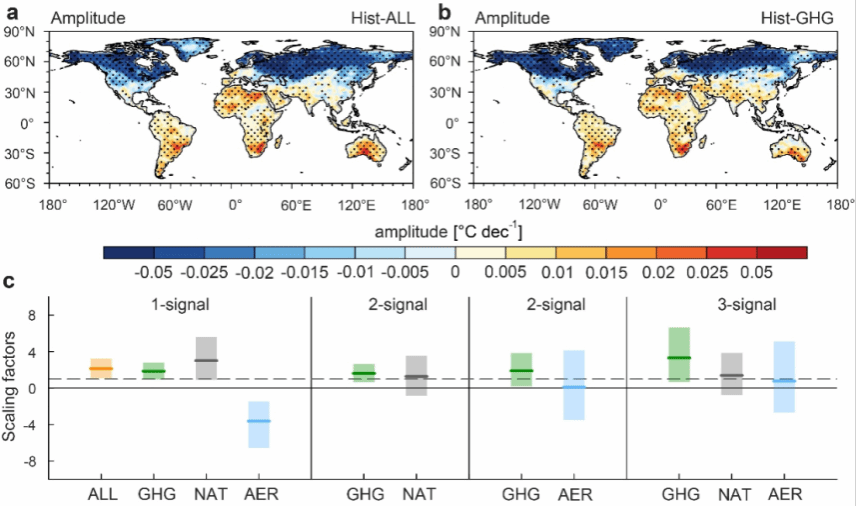
Simulation, Detection, and Attribution of Extreme Daily Temperature Range Events of Maximum Daily Temperature.
Lead researchers: Fu Congbin, Liu Qi, Ding Aijun, Xu Zhongfeng
Affiliations: School of Atmospheric Sciences, Nanjing University; Institute of Atmospheric Physics, Chinese Academy of Sciences (CAS)
A research team led by Fu Congbin, Academician of CAS, identified a new type of extreme event under global warming—rapid day-to-day temperature fluctuations—revealing its spatiotemporal characteristics, driving mechanisms, and health impacts. The study defines extreme inter-day temperature variability as events in which temperature differences between two consecutive days exceed the historical 90th percentile, commonly described as a "temperature rollercoaster." It finds that such events have intensified significantly in the mid- and low-latitude regions under global warming, with greenhouse gas emissions as the dominant driver. By 2100, under a high-emission scenario, their frequency, magnitude, and intensity are projected to increase by approximately 17%, 3%, and 20%, respectively, affecting regions inhabited by over 80% of the global population.
Mechanistically, global warming amplifies soil drought and enhances variability in land–atmosphere interactions, increasing day-to-day fluctuations in cloud cover and radiation, ultimately leading to rapid temperature swings.
In terms of health impacts, the study shows that extreme inter-day temperature changes are associated with a near-exponential increase in mortality risk, exceeding the effects of diurnal temperature fluctuation, and significantly elevating the risks of cardiovascular and respiratory diseases.
The study establishes this phenomenon as an independent scientific indicator and proposes recognizing it as a new category of extreme weather event.
Mechanisms of Global Urbanization Impacts on Terrestrial Ecosystems
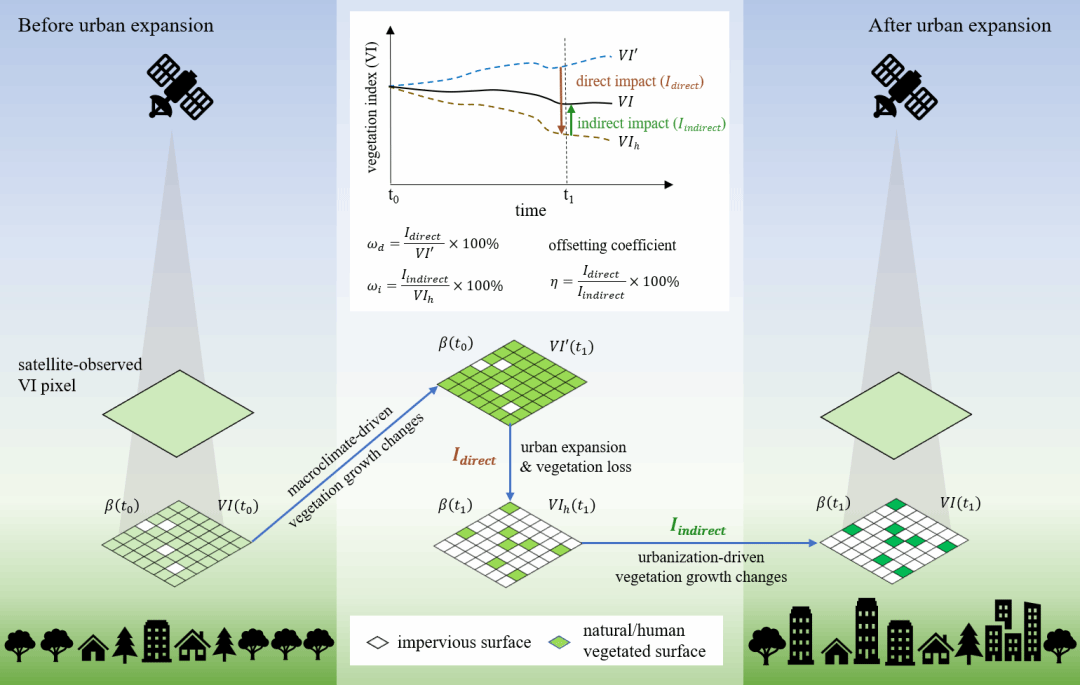
Schematic Diagram of the Impacts of Climate Change and Urbanization on Vegetation Dynamics
Lead researchers: Qiu Bo, Guo Weidong, Chen Jiuyi
Affiliation: School of Atmospheric Sciences, Nanjing University
This study systematically evaluates the impacts of global urbanization on urban vegetation coverage and growth conditions by integrating multi-source remote sensing data with climate and socioeconomic datasets.
Methodologically, the study develops an innovative framework that accounts for climate change when assessing the effects of urbanization on vegetation dynamics. It quantifies the influence of urbanization on vegetation trends across 4,718 cities worldwide from 2000 to 2019. The findings show that indirect effects of urbanization—such as environmental changes and human management practices that promote vegetation growth—offset 56.85% of the direct negative impacts caused by urban expansion. However, this compensatory effect exhibits strong spatial heterogeneity. It is significantly higher in the Global North (typically more developed economies) than in the Global South (generally less developed regions), and is closely associated with differences in socioeconomic development levels and stages of urbanization. Machine learning-based projections further suggest that this disparity is likely to persist in the future.
The study provides important insights for understanding global urban vegetation dynamics and contributes to advancing the United Nations Sustainable Development Goal of Sustainable Cities and Communities (SDG 11).